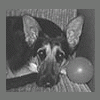
StarFox Posted December 7, 2004 Posted December 7, 2004 Zebra has been acting very..odd..lately. He is very scared to go outside. I guess this started about a month ago but untill resently hasn't been a big problem. This morning I took him out so he could do his buisness and I literally had to drag him out of the house to go outside. I kept saying in a happy, upbeat tone "Come on lets go out! Wanna go outside?!" He use to LOVE going out and playing and going for walks. Now he refuses. Once I actually get him outside and on the lawn he will see a car or a person and his tail will go down, ears back and his butt will drop very low. Then he will take off and run to the back door and scratch to get back inside. I just don't get it! Nothing tramatizing has happend to him outside that I know of, I'm always out with him so it's not like something could have happend that I didn't know about. This is becoming a HUGE problem to the point that he will only poop and pee on newspaper that I have to put down in our laundry room. I know, I know..it's so gross but he just won't go out anymore. I've tried to take him out and give him treats when he is being good. I've forced him to sit out there and watch cars pass by and people walk down the street. I never yell when he wants to come inside, I try to make his outside time as fun and exciting as possible. So any ideas on what to do or why he has gotten like this? I don't want to force him to go out anymore because it seems to be making things worse. I've also tried to take the newspaper away so he won't pee/poo inside...I thought that it would force him to do his buisness outside, but no. He will hold it in all day..and I mean ALL day and he still refused to go outside. Today alone he held everything in for over 15 hours! :-? I dunno what to do! Quote
imported_Kat Posted December 7, 2004 Posted December 7, 2004 That is indeed strange. Have you had Zebra's eyesight and hearing tested lately? Sometime when a dog has one sense compromised they become hostile to the world that exists outside their safe haven. When I was a kid of about 9 yrs old I used to walk 2 Border collies, lurcher and 2 shelties for the man and woman who has Meg and her friends now. One particular BC called Glen suddenly wouldn''t come out of his kennel when I went to walk the dogs over the fields. He was taken to the vets and it was discovered that his sight was failing and on top of that he had a stroke a few days later. When changes happen in a dogs body they change their behaviour so it would maybe be a good idea to get Zebra checked out. Good luck :wink: Quote
DogPaddle Posted December 7, 2004 Posted December 7, 2004 Maybe you can desensitize him gently. Get some rescue remedy to make it easier on him and borrow one of those plastic kennels, put him in that with a nice blankie and take that outside, he should feel more protected but still outside, then maybe move onto doing it with the door open and so on. Quote
courtnek Posted December 8, 2004 Posted December 8, 2004 I have to agree I think something scared him, maybe a noise that is totally familiar to you (so non threatening) but scary to him. Did a car backfire? tires squeal? you may not even remember it happened. Of course I agree with Kat to get him checked out, loss of vision or hearing can make dogs act weird. They think that Laurel has some hearing loss, and that may be contributing to her mostly irrational fears. Other than that, with irrational fears, you just have to take it slow. Go outside with him and sit on the lawn. Dont make a big deal out of him if he seems scared, thats just reinforcing that the fear is ok. Just sit there and talk to him as quietly as you can, starting with 5-10 minutes and moving up in time from there. Read aloud in a quiet, gentle voice. watch for signs that he is relaxing, and then praise him and treat him. It will take some time, theres no way to convince a dog with words that all is ok. Quote
StarFox Posted December 8, 2004 Author Posted December 8, 2004 Thanks everyone. I was thinking back today about what could have casued his fear and I think I might have figured it out. About a month and a half ago there was a LOT of fireworks that went off at this football field about 3 blocks away (stupid homecoming! :x ). Zebra was terrified that night and I had a hard time calming him down. I think that must have started the fear in him. I just didn't put 2 and 2 together since he was scared in the house. He is also afraid of loud cars/trucks/motorcycles when we go out so I'm sure that it's not helping him when he hears this stuff. I'm going to do like you all said and slowly start to desensitize him again. We have a gated porch so I can take him out and just sit with him untill he starts getting use to all the sounds and sights again. And I'm going to look in to Rescue Remedy too. I know Court and a few others use/used it but how long does it generally take to start working? Quote
imported_Matty Posted December 8, 2004 Posted December 8, 2004 http://www.peteducation.com/article.cfm?cls=2&cat=1551&articleid=2545 How is noise phobia treated? There is no "cure" for noise phobia, but there are ways to try to reduce the fear. First, refrain from giving rewards or punishment. This is extremely important. Petting, consoling, or even saying, "It's OK," may be interpreted by the pet as a reward for the fearful response. In the event of comforting a dog during a storm, for example, it may signal to the pet that the storm really is something he should be afraid of. Similarly, the pet should not be punished for showing fear. This will only increase his anxiety level. Usually treatment includes three other facets: medications, changing the environment, and behavior modification. Administer medications: Medications may be given individually or in combination. In some instances, the medication may be administered during an entire thunderstorm season. Others may be given when a storm or noisy event (Fourth of July fireworks) is expected. A common protocol is to give amitriptyline during the storm season, and valium when a storm is predicted. The valium or other quick-acting medication needs to be given prior to the development of any behavioral or physical signs of anxiety. If there is a chance of a storm predicted for the afternoon, the pet should start receiving the valium or similar medication in the morning. Pets who also exhibit separation anxiety may need a different combination of medications. Several combinations may need to be tried before the optimum regimen for a particular animal is determined. Many of the medications that would be used on a daily basis, e.g.; Amitriptyline, Prozac, and Buspirone, may take 3-4 weeks to see an effect. Examples of medications used include: Alprazolam (Xanax) Amitriptyline (Elavil) Buspirone (Buspar) Clomipramine (Clomicalm) Clorazepate (Tranxene) Diazepam (Valium) Fluoxetine (Prozac) Inderal Paroxetine (Paxil) Tranxene-SD Alternative therapies have also been used with some success. These include melatonin and flower essences such as Rescue Remedy. These two therapies take effect within an hour of administration, and should be given prior to the storm or other fear-producing event. Change environment: By changing the environment of the animal during the storm or noise, the anxiety level can be reduced. Changing the environment may reduce the volume level of the sound or help make the pet less aware of it. Increase vigorous exercise: The pet should receive vigorous exercise daily, and more so on a day when the fear-producing noise is likely to occur. The exercise will help to tire the animal, both mentally and physically, and may make her less responsive to the noise. In addition, exercise has the effect of increasing natural serotonin levels, which can act as a sedative. Reduce or block the noise level: "White noise," such as running a fan or air conditioner may aid in blocking out some of the fear-producing noise. Playing a TV or radio can have a similar effect. Allowing the pet access to the basement or a room without outside walls or windows may decrease the noise level. Closing the windows and curtains can also help reduce the noise. Some owners have placed foam earplugs or cotton balls in their pets' ears. Create a safe haven: Some pets feel more comfortable in a small space such as a crate or a small room like a bathroom (run the fan and leave the lights on). Some pets seek out the safety of the bathtub or shower during a storm. (Some have hypothesized that a pet may feel less static electricity if on tile or porcelain.) If the pet is comfortable in a crate, the crate can be covered with a blanket to add to the feeling of security. The door to the crate should be left open and the pet should not be confined to the crate, which could dramatically increase the stress level. Some pets, especially cats, may find that a closet or area under the bed makes a good retreat. Project a calm attitude: Pets are very aware of the mental state of their owners. If you are worried or nervous, this will add to the pet's fear. Your pet will look to you for direction, so keep an "upbeat" and "in charge" attitude. Maintain good health and nutrition: Health problems may increase the stress level of pets, and increase their anxiety. For instance, a dog in pain because of hip dysplasia may be more irritable and prone to other behavior changes. Diets too high in protein have been linked to some behavioral problems. Consult your veterinarian if you would like advice about changing your pet's diet. Behavior modification: Special techniques can be used to help change the animal's response to the noise. Counterconditioning: Using counterconditioning, the animal is taught to display an acceptable behavior rather than an unacceptable one as a response to a certain stimulus. In this way, a negative stimulus can become associated with a positive event. For instance, the only time the pet gets his most favorite treat, game, or toy, is just prior to and during a thunderstorm. Dogs who enjoy traveling may be taken for a car ride, or cats who love catnip, may be given their favorite catnip mouse. (Dogs who enjoy swimming will need to wait inside until the storm is over!) After a time, the pet will start associating an oncoming storm with getting to have his favorite thing. Desensitization: Using desensitization, the animal's response is decreased while he is exposed to increasing levels of the fear-producing stimulus. For noise phobias, the animal is taught to be calm when the noise level is low, and then the noise level is gradually increased. This process is generally more successful in dogs than cats. To desensitize a pet to thunderstorms: Obtain a commercial tape of a storm, or tape record one yourself (commercial tapes generally work better). Play the tape at normal volume to determine if it will induce the fear response. If it does, continue with the desensitization; if not, you will need to obtain a different tape. For some animals, a tape alone may not work, since there may be a combination of occurrences that provokes fear, e.g.; thunder plus lightning or changes in barometric pressure. For these animals, darkening the room and adding strobe lights may more closely mimic the storm, and may need to be included in the desensitization process. Play the tape at a volume low enough that the pet is aware of the sound, but it does not induce a fear response. For instance, the ears may be cocked towards the tape player, but you still have the pet's attention. In some instances, that may mean the pet needs to be in a different room from where the tape is playing. While the tape is playing at the low level, engage the pet in an activity in which you give the commands, such as obedience training or performing tricks. Give food or other rewards during the activity when the pet accomplishes what he is supposed to. If the animal shows signs of fear, stop and try again the next day, playing the tape at an even lower level. It is important that the pet not be rewarded while he is fearful or anxious. Sessions should last about 20 minutes. If the animal does not respond fearfully, during the next session, increase the volume slightly. Again, involve the pet in an activity and reward it for obeying commands. Continue increasing the volume gradually for each session. If the pet starts to show fear, decrease the volume. Repeat the sessions in various rooms of the house and with various family members present. When the pet does not show fear when the tape is played at a loud volume, you may want to try playing the tape for a short time while you are absent. Gradually increase the time you are gone while the tape is playing. When the pet appears to have lost his fear, the sessions can be reduced to one per week. In most instances, these sessions will need to be repeated weekly for the life of the pet. During an actual storm, use the same activities and rewards you used in the training sessions. To increase the chances of successful desensitization, the training process should take place during a time of the year when the actual noise will not be encountered: if the pet is afraid of thunder or fireworks, try desensitization during the winter; if afraid of gunshots, the training should take place outside of the hunting season. In most instances, it is best to discontinue any behavior-modifying medications during the desensitization process. Consult with your veterinarian before discontinuing any medications. Conclusion Fear of thunderstorms and other forms of noise phobia are common problems in dogs, and some cats. Administering medications along with changing the pets environment, and using behavior modification techniques can help ease the fear. Above all, do not give your pet any attention or reward when he is showing signs of fear; this will only reinforce the fearful behavior Quote
courtnek Posted December 9, 2004 Posted December 9, 2004 you will start seeing changes with Rescue Remedy in about 48 hours. The dog will seem calmer, actually almost sleepy, but dont worry about that. Zebra will still need desensitivation, but the RR will help calm him in the meantime. Once he gets calm, tyou can start rewarding him for staying that way for longer stretches of time. Once he is desensitized, you can discontinue the RR, but keep some on hand for Fireworks days... Quote



Recommended Posts
Join the conversation
You can post now and register later. If you have an account, sign in now to post with your account.